




Personalising content according to learning styles is just one way AI could enhance the customer journey for eCommerce clients. Joseph Hirst, Sales & Marketing Director at SOZO, has seen how powerful AI personalisation can be when used across multiple marketing channels – leading to faster engagement, quicker conversions and greater brand loyalty. This is what he says about how to get the most out of AI to boost the eCommerce buying cycle…
Did you know that it takes around 50 milliseconds for users to form an opinion about your website; judging its clarity (what is it?), relevance (can it help me?), and trustworthiness (do I trust it?) before deciding to act or bounce. That means if your content doesn’t immediately resonate with your prospect’s needs or intent, they’re likely to click off, and fast.
The most important ‘P’ in the eCommerce mix is no longer price or promotion; it’s personalisation. Customers expect brands to recognise them, understand their intent, and deliver consistent, relevant experiences across every touchpoint and channel. Not everyone browses, shops, or takes in information in the same way, so brands need to to communicate in ways that are most relevant to each individual customer.
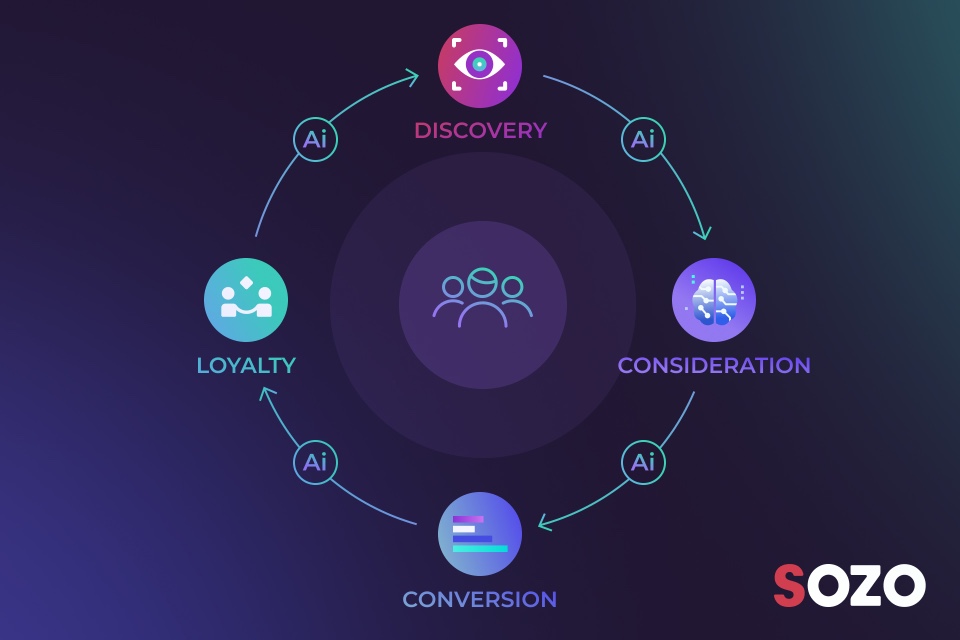
Looking ahead, AI is opening the door to a new level of personalisation: adapting content not just to what a customer wants, but how they prefer to engage. By analysing customer behaviour, context, and intent in real time, AI allows your brand to shape the shopping experience around individuals rather than generic audience groups. Its integration in the buyer cycle is quickly changing how customers discover, consider, convert, and stay loyal to your brand.
Here’s how AI-driven personalisation is reshaping every stage of the eCommerce buying journey.
Discovery: being visible and relevant
Discovery isn’t about being everywhere; it’s about being relevant in the key moments in the buying journey. Search engines, social platforms, online marketplaces, and large language models (LLMs) are now increasingly prioritising content that closely aligns with user intent.
Research by Forbes found that 81% of customers prefer companies that offer a personalised shopping experience, revealing just how important relevance is in the buyer journey. AI can help your eCommerce brand present the right products and content to the right people at the right time. This could include personalising homepage or landing page copy based on search intent, showing different product imagery or video depending on browsing behaviour, or tailoring ad creative to reflect a customer’s previous interactions. This contextual relevance increases the likelihood that a customer will engage rather than bounce.
Consideration: providing relevant information in all forms
The consideration phase is often the longest and most complex part of the buying journey, with research suggesting that it can take as many as 20-50 touchpoints (depending on purchase value) before a prospect is ready to convert. A customer may consume long-term content, short-form social posts, product videos, FAQs, reviews, comparison guides, emails, and more during this stage. You need to provide content that can inform, reassure, educate, and inspire a buyer about your brand and product, across multiple devices and channels.
AI-driven personalisation ensures that your customers aren’t overwhelmed with irrelevant information. It can tailor the content that you present to prospects based on their past behaviour and current intent signals, ensuring they receive all the relevant information they need to make a purchase.
Conversion: removing friction and building confidence
Personalisation becomes a powerful lever for action as users move towards conversion. Research by Barilliance shows that personalised product recommendations account for up to 31% of eCommerce revenues. Therefore, when a customer is ready to buy, the factors that influence their decision (product recommendations, pricing cues, imagery, calls-to-action) must feel personal.
AI can dynamically adapt your product recommendations, messaging, imagery, pricing signals, and even your onsite layouts based on factors such as customer location, browsing behaviour, purchase history, and previous engagement. This removes friction from the buying process and reinforces trust at those critical moments, helping your audience feel ready to convert rather than pushed to do so.
Loyalty: turning transactions into relationships
The buying journey doesn’t end at checkout. In fact, this is where some of the most valuable personalisation opportunities begin and loyalty is built. A report by Segment reveals that 56% of consumers say they will become repeat buyers after a personalised experience, demonstrating how personalisation directly influences loyalty.
AI can help your brand stay useful and top-of-mind beyond the initial purchase, transforming one-off transactions into meaningful, long-term relationships. It can be used for everything from personalised email journeys and timely replenishment reminders, to creating content and offers exclusively for each customer. Customers who feel recognised and valued are far more likely to return, as well as advocating for your brand.
A note of caution: don’t neglect human insight
It’s important to remember that while AI can unlock incredible opportunities for your eCommerce brand, the most effective personalisation strategies are still rooted in human insight. AI can optimise delivery at scale, but it cannot fully replicate empathy or emotional understanding. If you rely solely on automation, you risk creating experiences that feel too impersonal or transactional, which can quickly erode trust.
You’re selling to people, not to bots, so make sure you don’t neglect human insight in your eCommerce strategy. You should base your campaigns on human-led strategy, and use AI as your execution engine. The brands that will win in this space won’t just be the most technologically advanced; they’ll be the most human.